All new boilers have to be condensing by law, as they’re much more efficient than non-condensing units. But what is a condensing boiler system, and how do they operate differently from their non-condensing counterparts?
We’ve put this guide together so that you’ll know all the benefits of installing a condensing boiler, how they operate, and where to start when looking to purchase one.
Already got your eyes out for a condensing boiler? It's worth mentioning that your journey is likely only beginning! Most prospective homeowners find themselves swamped in weeks of stressful research and quote comparison.
Look no further than Boiler Guide to take care of all the hard work for you. With our extensive network of trusted Gas Safe registered engineers in your area, we can deliver you 3 free quotes tailored to your specific needs, free of obligations and charges.
Simply fill in our quick 30-second survey from the button below and take advantage of our services!
As a boiler burns fuel it produces water vapour. This water vapour, or steam, contains heat which can contribute to warming up the central heating.
However, up until condensing boiler technology was developed, this heat went straight out of the flue pipe. As such, a sizeable percentage of heat produced by the boiler was being lost. As a result, the boiler would need to use more fuel to make up for that loss.
Condensing boilers work on a 'Flue Gas Recovery System', which recycles the heat from the steam and stops it from being lost. This means that modern heating systems are now more efficient than ever.
Thanks to condensing boilers, the same amount of heat and hot water can be delivered to your home using much less fuel than a non-condensing boiler.
Condensing Boiler Regulations have been introduced since 1st April 2005 which state that all new and replacement boilers must be condensing.
What is a non-condensing boiler?
Rather than recycling heat that would be lost, non-condensing boilers allow the heat to escape through the flue pipe. This is an incredibly inefficient process that's bad for the environment.
Up to 30% of the heat generated by a non-condensing boiler can be lost. So, by updating to a condensing boiler, you could reduce your energy bills and help the environment.
How does a condensing boiler work?
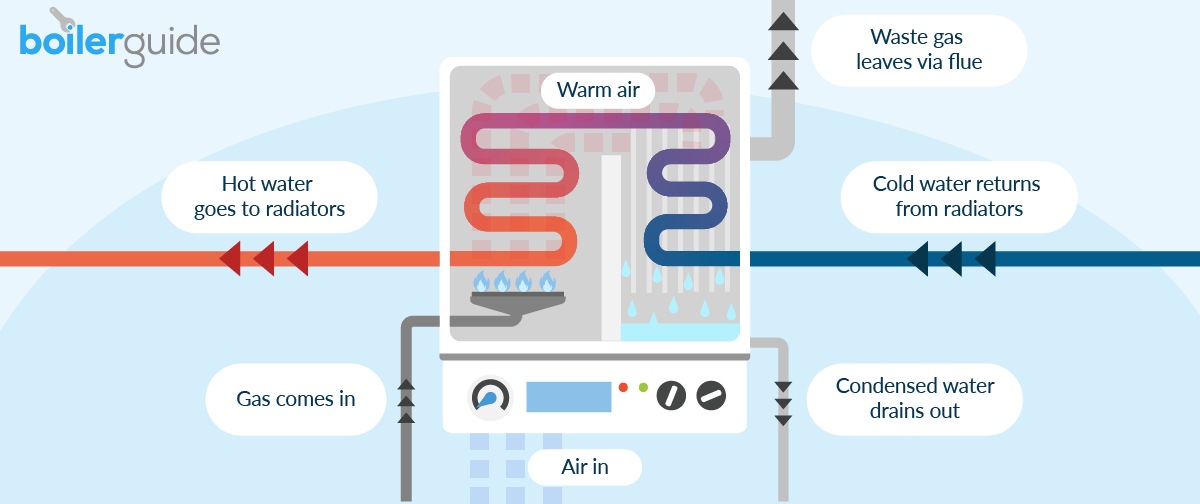
Condensing boilers use a Flue Gas Recovery System that includes 2 heat exchangers to harness the heat that would otherwise be lost.
As gas or oil central heating boilers work to heat the home, burning the fuel results in waste gases being produced. These waste gases must be expelled out into the atmosphere via the flue pipe, otherwise, they could prove harmful to those on the property. While this is an essential safety feature, the waste gases carry heat that could otherwise be used to contribute to heating the home.
As the cool water returns from the radiators into the system and picks up latent heat, and then condenses. The excess condensed water is drained out and then safely disposed of. The water continues to flow through the chamber and takes up the heat before going back into the system as hot water towards the radiators.
Therefore, a condensing boiler has the same heat input as a non-condensing boiler, but you save more energy because more heat is being extracted and put into the water that goes back into the radiators. By recycling this excess heat, condensing boilers can use less fuel to meet the same demand for central heating as a non-condensing boiler. This means that they achieve efficiencies of over 90%.
Condensing boiler diagram
Condensing boilers achieve their efficiency by recovering energy in the form of heat that otherwise would have gone to waste. Our diagram of a condensing boiler below shows the simplified version of the heating process that's happening inside.
Condensing boiler temperature
You may be wondering what temperature should a condensing boiler be set at. Well, condensing boilers differ from non-condensing ones as they need lower temperatures to recover lost heat through exhaust gas condensation. If the water temperature is too high, then condensation isn’t possible.
This process is called "condensing" because the heat is turned back into water before exiting the flue via the second heat exchanger. The boiler operates in 'condensing mode' when the returning water temperature is below 54°C, allowing it to reclaim lost heat.
By extracting more heat during the fuel-burning process, condensing boilers achieve energy efficiency of over 90%, while non-condensing boilers sometimes only reach about 70% efficiency.
Therefore, the correct condensing boiler temperature setting is 70°C for central heating and 60°C for hot water.
How much does a condensing boiler cost?
Prices typically range from £500 to £2,000 for a condensing boiler, but these figures will vary depending on the brand, model and the length of the warranty.
In addition to the cost of the boiler, the price of installation must be factored in too. Condensing boiler installation will potentially cost £500 – £1,000 but, again, this will vary depending on the complexity of the installation and rates charged by the installer (this can be affected by the time of year and your location).
Type of boiler
Typical price range (excluding installation)
Average price of boiler fully installed
Combi
£500 – £4,600
£2,000 – £4,800
System
£580 – £3,500
£2,200 – £5,300
Regular
£500 – £3,900
£2,200 – £5,300
These prices don't include the cost of a hot water cylinder which is an essential part of a heating system that includes a regular or system boiler.
To find out all of the costs involved, read our guide to the new boiler cost.
Already got your eye on a boiler for your home? Ensuring that you make the right choice goes further than just the first pick. Customers often find themselves spending weeks on quote comparisons and online research. Here at Boiler Guide, we want to save you the headache by vetting installers for you!
Simply click the button below to begin, and we will deliver 3 free quotes to you from accredited Gas Safe Registered engineers, free of charge and obligations.
Condensing boilers are all-encompassing. Whether it's a combi, regular or system, any type of boiler can be condensing, no matter whether the unit runs on gas, oil or LPG.
The type of boiler that's best suited to the heating and hot water demands of your property will allow you to benefit from condensing technology. There are three main types:
Combi boilers are the most modern boiler type and they've quickly become the most popular. Rather than needing any external tanks or cylinders, combi boilers are single cost-effective units that deliver heating and hot water on demand.
System boilers are similar to combi boilers in the sense that they take water from the mains. The difference is that rather than delivering hot water on demand it's stored in a hot water cylinder. This means that system boilers can meet higher demands for domestic hot water compared to combi boilers.
Regular boilers go by many names, including conventional, heat-only and open-vent. They're the most traditional boiler, often found in large, older properties. Rather than taking water directly from the mains, water is fed to the boiler from a cold water cistern in the loft. The central heating system is then heated directly by the boiler while domestic hot water is stored in a cylinder.
Whether your boiler runs on natural gas, oil or LPG is likely to depend on whether you're connected to the gas network. Most UK properties have a gas boiler, a fuel that is delivered directly to the property via pipes. Not all properties are connected to the gas network, however, which is when oil or LPG – two fuels that can be stored on-site – can be used.
Condensing boiler efficiency
Whilst your average conventional boiler can – at best – achieve an efficiency of 70-80%, condensing boilers can often reach, or even exceed efficiency levels of 90%.
These highly efficient boilers owe their impressive performance to the ingenious combustion chamber design, which not only extracts heat from the fuel but also from the water vapor condensation in the form of thermal energy, leaving little to no heat to waste.
With this technology, a condensing boiler can deliver an extra 15-30% efficiency ahead of its conventional counterparts, thus saving you on home energy bills as well.
Condensing boilers pros and cons
If you have installed a new boiler since 2005, it is almost certainly a condensing boiler. This is because it is largely illegal to install non-condensing boilers in the UK since 2005, apart from very rare special exemptions on behalf of the government.
Condensing boilers are far more efficient than their non-condensing counterparts, which means they waste much less energy and produce fewer carbon emissions. Nonetheless, condensing boilers come with their own perks and limitations that should be considered in your decision.
If you want to explore more carbon-friendly solutions other than condensing boilers, consider some alternatives to condensing gas boilers.
Advantages of condensing boilers
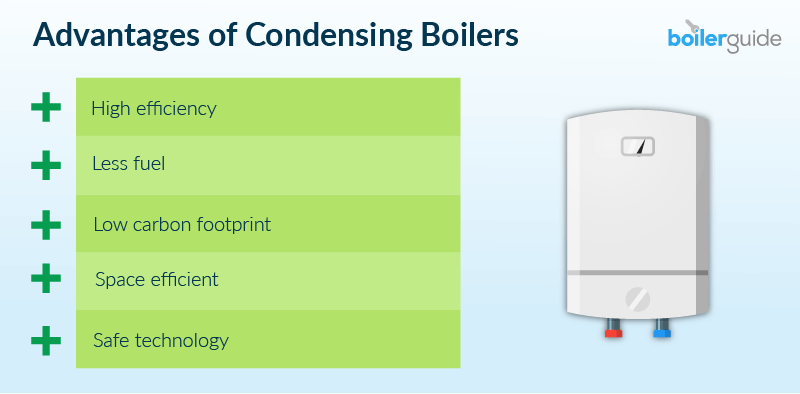
It's no secret that condensing boilers surpass their conventional counterparts in many different avenues of comparison. Here are some of the key advantages associated with condensing boilers:
High efficiency: Condensing boiler efficiency is, on average, 15-30% higher than non-condensing boilers. For example, a G-rated boiler could be as low as 60% efficient while an A-rated boiler is at least 90% efficient.
Less fuel: Highly efficient performance means that the boiler can deliver the same level of central heating using less fuel. Using less fuel will then result in lower energy bills.
Low carbon footprint: Because condensing boilers use less fuel, they help households reduce their total carbon footprint by up to 3 tonnes of CO2 every year. That’s the equivalent emissions of charging your mobile phone over 360,000 times!
Space efficient: Condensing boilers don't require any specific form of ventilation as non-condensing units do which helps to save space.
Safe technology: While non-condensing boilers take air in from the property, condensing boilers are sealed systems. The only air they take in comes from outside of the property through the flue pipe. Additional safety features, such as pressure relief valves, will turn the boiler off in the event of a fault.
Disadvantages of condensing boilers
All boilers, whether condensing or not, can potentially encounter various issues through use, yet one issue unique to condensing boilers is a frozen or blocked condensate pipe.
The condensate pipe – fitted either internally or externally – disposes of acidic water from the condensing process. Externally installed pipes can be subject to freezing, causing boiler blockages.
Luckily, thawing out a frozen condensate pipe can be a simple home fix. You can do so by:
Holding a hot water bottle, microwaveable heating pack, or warm cloth over the frozen area.
Using a watering can to pour hot water (never boiling water) over the frozen part of the condensate pipe.
Boilers can run into many different problems over the years, regardless of their type. Here are some of the more common boiler issues, and how you can resolve them:
Kettling: Limescale buildup on the heat exchanger can overheat the water, creating a kettle-like whistling noise. If you experience this, it is best to contact a licensed heating engineer to flush the system of built-up debris.
Leaks and dripping: Any water leakage from your boiler will generally require a professional diagnosis and repair. If you notice water leakages, turn off the boiler and water supply, and contact a heating engineer to find the root cause and solve it.
No heating or hot water: There may be several reasons why this issue takes place, and often will require the attention of a heating engineer. In any case, it is worth checking your thermostat to make sure it is working and set correctly. Low boiler pressure is also a common culprit for this issue.
Low boiler pressure: If your boiler pressure is low (below 1 on the pressure gauge), you can try increasing the pressure by using the filling loop. To do this, turn the boiler off and wait for it to cool down. You can then attach the filling loop to the boiler, and open its valve to allow mains water to flow into the system. The boiler pressure gauge should begin to increase. An appropriate pressure level is usually 1-2 bar.
Cold radiators: Air can build up in the radiators, causing blockages that prevent hot water from circulating. When this happens, it is necessary to "bleed" the radiators of the trapped air. A licensed heating engineer can handle this for you.
Ultimately, the best way to maintain a healthy boiler is to schedule an annual service with a Gas-safe engineer or licensed heating engineer. They'll best ensure your boiler’s safety and longevity, identify potential issues, and keep your warranty valid.
Ready to find the perfect condensing boiler for your home? Save yourself countless hours of stressful research by letting us handle the vetting process. Leverage Boiler Guide's vast network of Gas Safe registered professional installers right in your area.
Simply click the button below, and get ready to receive 3 free quotes tailored to your specific home needs. No pay, no obligations!
When looking for the best condensing boiler for your home, it’s important to consider various factors. Here are some points of interest:
Output rating (kW): The higher the output rating of a boiler, the more heat the boiler is capable of producing. The output rating that is best suited for your home will depend on its size, and your energy requirements.
Efficiency rating (ErP): This tells you the efficiency of a boiler in converting fuel to energy. A+ is the most efficient, while G is the least efficient.
Warranty: Manufacturers tend to have different warranty conditions. Standard warranties tend to range from 1-5 years, while, reputable manufacturers with long warranty programs of 2-12 years can help extend the life of your boiler.
Cost: Boiler prices vary depending on many different factors such as output, manufacturer, and model. Not to mention, installation prices can vary too.
Customer reviews: The experience of other product owners can help give you an idea of what to expect, and the reliability of a manufacturer’s products.
Installer reviews: Getting quotes and opinions from multiple installers and heating engineers can help you make the most informed decision.
While it’s easier said than done, researching and contacting installers can see you stuck in an endless cycle of websites and phone calls. To save you countless valuable hours, let Boiler Guide take care of the vetting process for you!
Through our services, you can obtain up to 3 free quotes from our network of trusted installers in your area. That way, you can be assured to make the best decision suiting your home for a fraction of the time.
Simply click the button below to get your free boiler quotes now, and have your chosen condensing boiler professionally installed without delay!
The best gas boilers are manufactured by Baxi, Ideal, Vaillant and Worcester Bosch. Each of these boiler brands manufactures multiple ranges, so we've picked out their best selling gas boiler range in the table below.
Brand
Best selling Range
Types of boiler available
Baxi
800
Combi and system
Ideal
Vogue Max
Combi and system
Vaillant
ecoTEC Plus
Combi, system and regular
Worcester Bosch
Greenstar 4000
Combi, system and regular
LPG conversion is available on Ideal Vogue Max and Worcester Bosch Greenstar 4000 boilers as well as some models in the Vaillant ecoTEC Plus range.
To install a new gas condensing boiler, you will require the service of a certified heating engineer to carry out the installation. Here at Boiler Guide, we have a country-wide network of certified heating engineers that we can connect you with.
Getting started is easy! Simply fill out our 30-second online form and you'll be provided with 3 free, home-tailored quotes from certified installers in your area, giving you the freedom to choose the best bargain. Click the button below to begin!
For properties that aren't connected to the gas network, there's no shortage of condensing oil boilers to choose between. In addition to the different boiler types, some oil boiler models are available for internal or external installation. Underneath you’ll find some of the best oil boilers (condensing) in terms of sales.
Brand
Best selling Range
Types of boilers available
Firebird
Envirogreen
Internal and external combi, regular and system boilers
Navien
LCB700
Internal and external regular and system boilers
Viessmann
Vitorondens 200-T
System
Worcester Bosch
Greenstar Heatslave II
Internal and external combi boilers
What size condensing boiler do I need?
Boiler output size is an important factor to consider when making your choice, as it will determine how much heat and hot water your boiler can produce. If you choose a boiler that is too small, it won't be able to meet your needs. Alternatively, if you choose a boiler that is too big, you'll waste energy and money.
The table below shows the recommended output ranges for condensing boilers, based on the number of bathrooms and radiators in your home:
Number of bathrooms
Number of radiators
Recommended Output
1
Up to 10
24-27 kW
2-3
Up to 15
28-34 kW
3+
Up to 20
35 – 42 kW
Our guide to What Size Boiler Do I Need? goes into more detail about finding an appropriate boiler size for your home.
What makes condensing boilers worth it?
With all things considered, condensing boilers emerge as a highly reliable, safe, and energy-efficient solution for your home needs.
Before the introduction of condensing boilers, up to 30% of produced heat was directly lost out of the flue pipe and wasted, whereas with the ingenious design of the combustion chamber and a Flue Gas Heat Recovery system, condensing boilers now exhibit an impressive efficiency rate that is 15-30% higher than their conventional counterparts.
Condensing boilers come in all types – combi, regular, or system – and most leading manufacturing brands boast impressive models for you to choose from.
Get quotes for a condensing boiler
To get the most competitively priced quote for the installation of a new combi boiler, we highly recommend comparing multiple quotes. However, taking dedicated time to obtain and compare various quotes can see you spend weeks on research. Luckily, Boiler Guide is here to help you out.
By completing our simple online form, you can get free boiler quotes from up to 3 heating engineers based in your local area. Each company will then be in touch to arrange a date and time to quote for a new condensing boiler. Simply click the button below to begin, and enjoy your free quotes free of charge and obligations!
Is a condensing boiler the same as a combi boiler?
When comparing a condensing vs combi boiler, it’s important to know that a combi boiler is one of the 3 types of condensing boilers. The other 2 types are system boiler and regular boiler (also known as conventional boiler). The different boiler types serve different purposes depending on your household, current heating system, and heating needs.
Are condensing boilers any good? Condensing boilers are more energy-efficient than non-condensing boilers because they're able to use less heat and capture more heat. Because condensing boilers are 15-30% more efficient than non-condensing boilers, the UK introduced condensing boiler regulations which mandate that new boiler installations must be condensing boilers.
What are the best condensing combi boilers?
To find the best condensing combi boiler for your home, you need to consider many factors that make your situation unique. For example, some things you need to consider are your current heating system, heating and water demand, household size, and your budget.
What is the efficiency of condensing boilers?
When compared to non-condensing boilers, the energy efficiency of condensing boilers is 15-30% more efficient as they are able to capture more heat. Their energy efficiency can go above 90%. Because of this, homeowners are able to save more on energy bills as less heat is going to waste.
What is a condensing oil boiler
For off-grid households, oil boilers are the preferred heating method. In comparison to non-condensing oil boilers, modern condensing oil boilers convert more fuel into heat. If you have an old non-condensing oil boiler, now is the time to replace it.
Do I need a hot water tank with a condensing boiler?
Condensing boilers do not generally require a hot water tank in order to function. This will depend on your existing boiler system, or chosen type of condensing boiler.
About the author
Becky Mckay
Becky has been a writer at Boiler Guide since 2021. Her vast boiler knowledge means she’s ready to help with any home heating query, big or small!
Compare boilers
Try our boiler comparison tool
Find the best boiler for your needs, or see how the latest A-rated boilers compare with each
other and your existing one.